For years, final-mile performance was often judged by one question:
Did the product arrive?
For furniture retailers, manufacturers and e-commerce brands, that question is no longer enough.
A sofa can reach the correct address and still fail to reach the living room. A wardrobe can arrive on time but remain boxed when the customer expected assembly. A dining table can be delivered successfully while damaged components create another appointment, another customer-service case and another cost.
The transport journey may be complete.
The customer outcome may not be.
For large-format furniture, the most sensitive part of the delivery often begins after the vehicle reaches the customer.
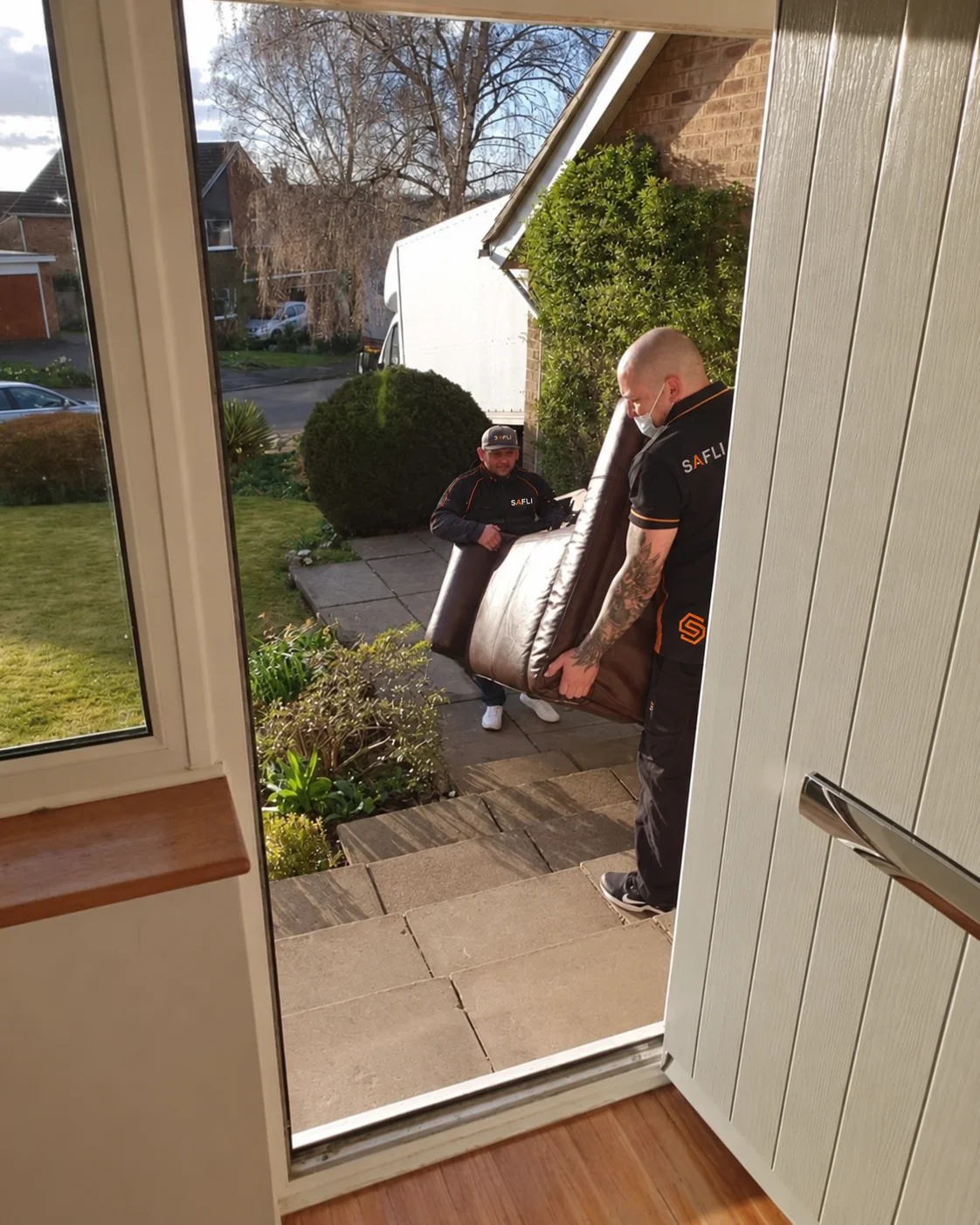
The final few metres between the vehicle and the intended room can determine whether an otherwise successful order becomes a positive experience, a complaint, a return, a replacement request or another service issue.
For businesses looking seriously at furniture delivery performance, the doorstep is no longer the finish line.
The difficult part often begins at the property
Warehouses and distribution centres are controlled environments.
Access is planned. Loading areas are designed for controlled product handling. Equipment is available. Routes are known and operating processes are established.
A customer’s home introduces a completely different set of variables.
Narrow entrances • stairs • lifts • restricted parking • tight turns • delicate flooring • existing furniture • limited manoeuvring space
Then there is the product itself.
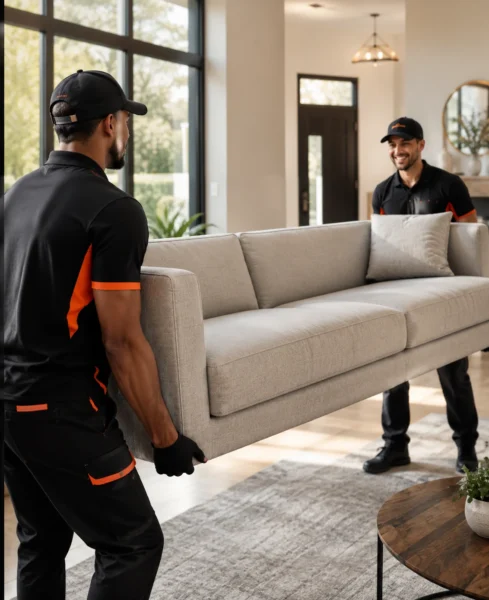
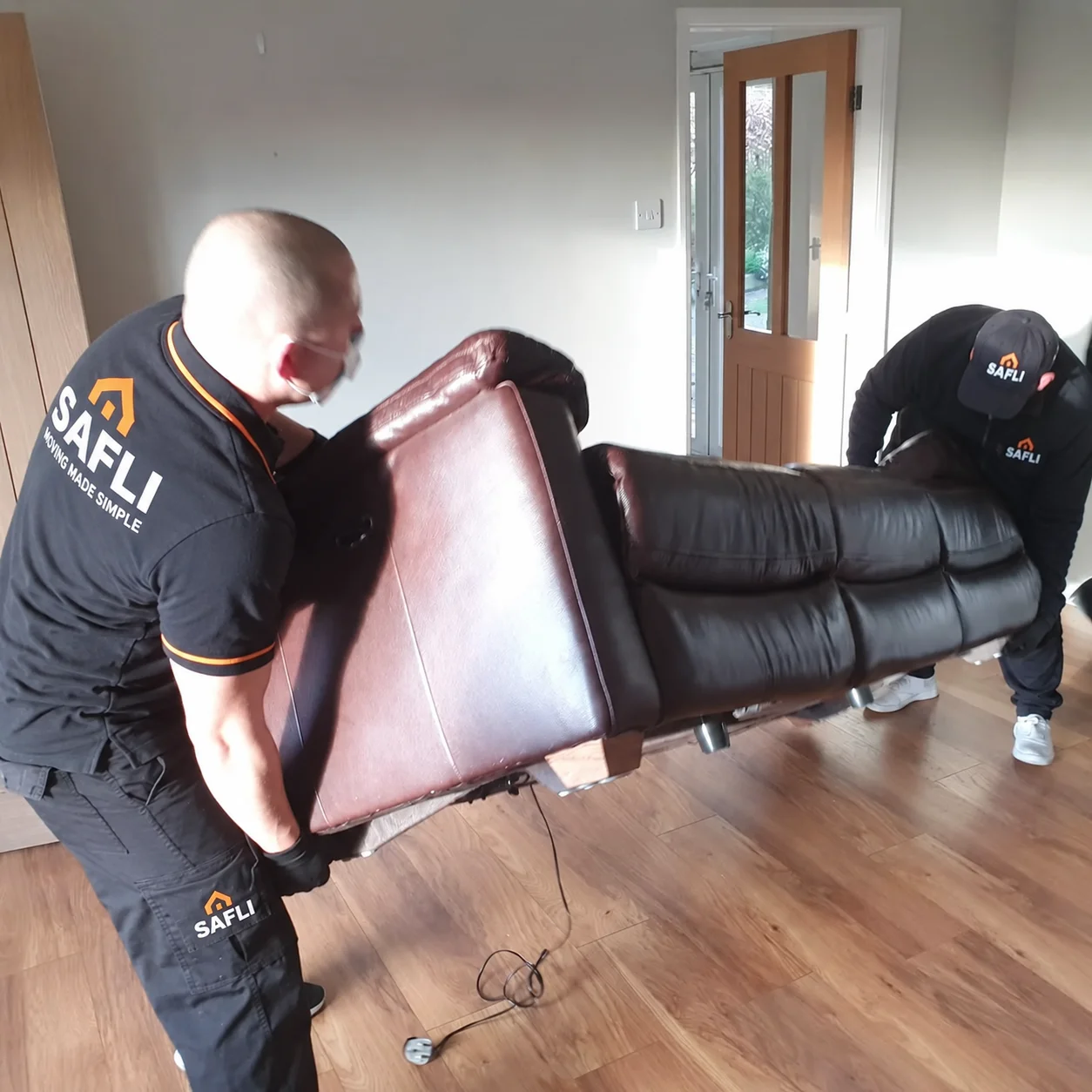
A sofa, bed, wardrobe, dining set or modular furniture system cannot be treated like a parcel.
Its dimensions matter. Its construction matters. Its weight and handling requirements matter. The route through the property matters. And the position in which the customer expects it to finish matters.
This is where standard doorstep delivery reaches its natural limit.
The vehicle may have reached the address, but the part of the service that matters most to the customer may still be ahead.
Delivered does not always mean completed
A delivery management system may show:
Delivered – 14:32
Operationally, that looks successful.
But the status alone does not explain what actually happened inside the property.
Was the product placed in the agreed room? Was access successfully managed? Was assembly completed where required? Was packaging removed if that formed part of the service? Was damage identified and recorded? Was the product left in the condition and position promised to the customer?
A delivery can therefore be technically successful while creating a commercial problem.
That distinction matters because an incomplete outcome rarely stays within transport.
It can trigger:
Customer-service contact • rescheduling • additional transport • product recovery • replacement components • warehouse handling • refunds • compensation • management time
One order can quickly become several additional processes.
The better question is not simply:
“What did the delivery cost?”
It is:
“What does an incomplete delivery cost the wider business?”
Furniture customers are buying an outcome
When a customer purchases a sofa, bed, wardrobe or dining table, they are not thinking about route planning, depot utilisation or linehaul.
They are thinking about the finished product in their home.
The sofa in the living room. The bed assembled upstairs. The wardrobe positioned where it belongs. The dining table ready to use.
That is the outcome the customer believes they have purchased.
The logistics operation sits between the retailer’s promise and that final result.
That means the service specification needs to establish more than when the vehicle will arrive.
It should define:
Where the service finishes • who is responsible for room placement • how access is managed • whether unpacking is included • whether assembly or installation is required • what happens to packaging • what evidence confirms completion
It should also establish what happens when the promised outcome cannot be achieved.
These are not minor operational details.
They define the customer’s experience of the purchase.
The delivery team represents the retailer inside the home
This becomes particularly important when the final mile is outsourced.
A customer may never meet the people who designed the product. They may never visit the warehouse. They may never speak to the retailer’s logistics department.
But they will meet the delivery team.
For the duration of that appointment, those people become a physical representation of the business that sold the product.
Communication matters. Presentation matters. Product handling matters. Respect for the property matters. How problems are dealt with matters. And the condition in which the product and room are left matters.
The final mile is therefore more than a transport function.
It is a customer-facing brand interaction taking place inside the customer’s home.
That requires a different standard from simply getting goods from one location to another.
Room-of-choice changes what delivery means
Room-of-choice may sound straightforward.
Operationally, it is not.
Once a product passes the threshold, the team may need to consider:
Product dimensions • entrances • stairs • turns • lifts • flooring • walls • surrounding furniture • safe handling • final positioning
The question changes from:
“Can we reach this address?”
to:
“Can we safely achieve the placement promised to the customer?”
That is an important distinction.
Specialist home delivery is not simply a two-person version of standard delivery.
It is about designing the service around what needs to happen once the product enters the property.
When room-of-choice is managed properly, the service ends where the customer expected it to end:
With the product in the room where it is actually intended to be used.
Assembly and installation form part of completion
Many furniture products require more than placement.
Beds may need assembling. Tables may require frames or legs fitting. Wardrobes and modular systems can require more substantial assembly. Other products may require adjustment, positioning or agreed installation work.
If the product reaches the room but cannot be used as intended, the customer may still consider the order incomplete.
Poorly managed assembly can create its own operational problems:
Misaligned components • damaged fittings • missing parts • incorrect positioning • repeat appointments • replacement requests
Where assembly or installation forms part of the customer promise, it needs to be built into the operating process before the delivery takes place.
The team should know:
What product is arriving • what work is expected • what equipment is required • what the finished outcome should look like
Assembly should not be treated as an afterthought to delivery.
It is part of completion.
The most expensive delivery problems are often predictable
Many delivery problems are not random.
Patterns usually exist.
Certain product ranges may generate disproportionate customer-service contact. Certain property types may repeatedly create access issues. Some routes or regions may experience recurring capacity pressure. Some services may create more second visits than others. Peak trading periods may expose weaknesses that remain hidden during normal volumes.
Returns may begin accumulating because the reverse journey has not been designed as carefully as the forward journey.
These patterns should be treated as operational signals.
A business does not necessarily need to rebuild its entire delivery network because one part is underperforming.
It may only need to identify the pressure point.
One product range • one difficult route • one region • one delivery day • one backlog • one returns flow • one peak period
Once the problem is isolated, specialist capability can be introduced around it.
That is very different from replacing an incumbent logistics provider or restructuring an entire network.
Better final-mile performance should reduce work elsewhere
A strong furniture delivery operation does more than create a better customer experience.
It reduces friction across the business.
A properly completed appointment means fewer questions for customer service. Clear completion evidence gives operations teams better visibility. Accurate exception reporting makes the next action easier to determine. A controlled return prevents products sitting unresolved with customers. Correct assembly reduces the likelihood of another appointment.
The value of better final-mile performance therefore extends well beyond the doorstep.
It removes avoidable work from the wider operation.
That is important because the true value of specialist furniture logistics is not only what happens in the customer’s home.
It is also what no longer needs to happen afterwards.
Proof of delivery should explain the outcome
Traditional proof of delivery confirms that a delivery took place.
For specialist furniture logistics, that may not be enough.
Depending on the agreed service, useful completion information can include:
Customer signature • photographs • final placement • assembly outcome • collection record • exception reason
The purpose is not additional administration.
It is visibility.
If a customer contacts the retailer later, the operations team should not have to reconstruct the entire appointment through phone calls and assumptions.
They should be able to understand:
What happened • what was completed • what was not completed • why • what needs to happen next
That gives the business control over the outcome rather than simply proof that somebody attended the address.
Reverse logistics needs the same discipline as forward delivery
Not every furniture journey ends successfully.
Products may arrive damaged. Customers may require exchanges. Deliveries may fail. Items may need collecting. Returns may need to go back to a warehouse, store or another agreed destination.
For many businesses, the outbound journey receives far more attention than the reverse journey.
That can leave customer-service teams chasing collections, operations teams trying to locate products and warehouses waiting for stock that has not yet returned.
A mature furniture logistics model plans both directions.
Forward logistics gets the product to the customer.
Reverse logistics gives the business control when the product needs to come back.
Both affect the customer experience.
And both need a defined process, clear evidence and an agreed destination.
What should furniture businesses actually be measuring?
The conversation should move beyond vehicle availability and price per drop.
Operations leaders should be asking:
Those questions reveal far more about the strength of a furniture delivery operation than simply confirming whether the vehicle reached the postcode.
Price per drop does not tell the whole story
For procurement and operations teams, delivery cost will always matter.
But comparing providers only on the cost of the original delivery can hide the wider economics.
A lower-cost service that produces more failed placements, customer calls, repeat appointments, returns or product recovery may not ultimately be the lower-cost option.
The more useful calculation is:
The cost to complete the customer outcome.
That includes what happens after an unsuccessful first visit.
A specialist service should therefore be judged not only by the cost of completing the delivery, but by its ability to reduce avoidable activity around it.
For businesses selling large, high-value or service-sensitive products, that distinction can materially change how delivery performance is viewed.
A lower-risk way to improve the final mile
Improving the final mile does not necessarily mean replacing an established carrier or handing over an entire delivery network.
If one part of the operation is creating the problem, start there.
A retailer may already have an internal fleet or logistics partner performing well across most of the network. The difficulty may be limited to a particular product range, difficult delivery area, room-of-choice requirement, assembly programme, backlog, returns flow or peak period.
Keep what already works. Strengthen the part that does not.
A specialist provider can then be tested against a real operational problem.
Start with:
One trial day • one route • one delivery run • one product range • one region
Agree what successful completion should look like.
Then measure:
Completion • customer feedback • exceptions • repeat appointments • operational impact
If the improvement is there, expand the programme.
If it is not, the business has not been forced into large-scale change.
For an operations director, logistics manager or business owner, that is a far more controlled decision.
Where specialist capability becomes useful
The strongest approach is rarely to change every product, route or delivery partner at once.
Instead, define the part of the operation creating the problem and establish what a better outcome needs to look like.
That may involve:
The product • customer promise • access • handling requirement • placement • assembly or installation • evidence • exceptions • returns
From there, specialist support can be built around the actual requirement rather than a generic delivery model.
This is the part of the furniture journey SAFLI is built around.
SAFLI
Specialist Assembly • Furniture Logistics • Installation
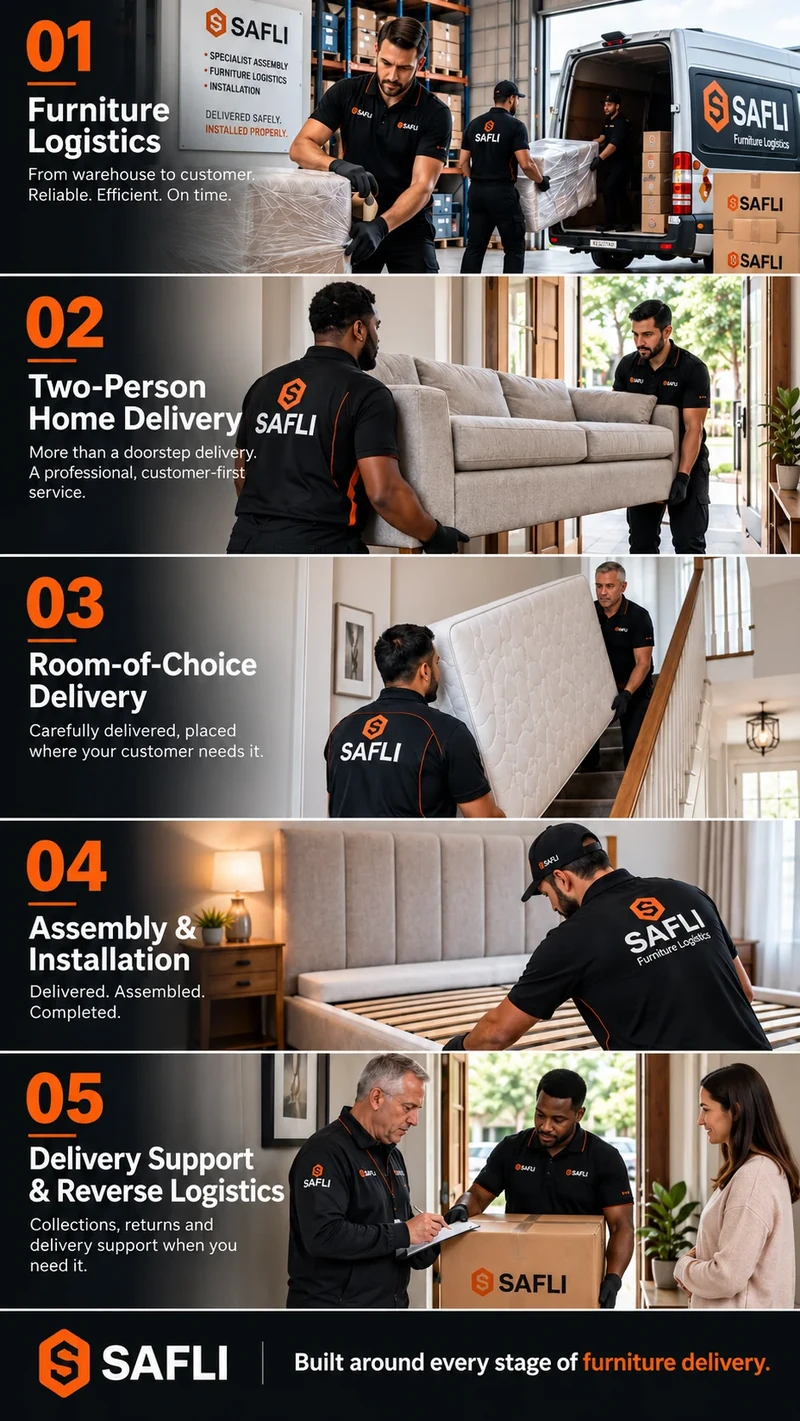
SAFLI provides specialist customer-facing furniture logistics for retailers, manufacturers, e-commerce brands and logistics partners.
Our focus is not simply getting products to an address.
It is supporting the point where the product, the property, the customer expectation and the retailer’s brand meet.
SAFLI capability includes:
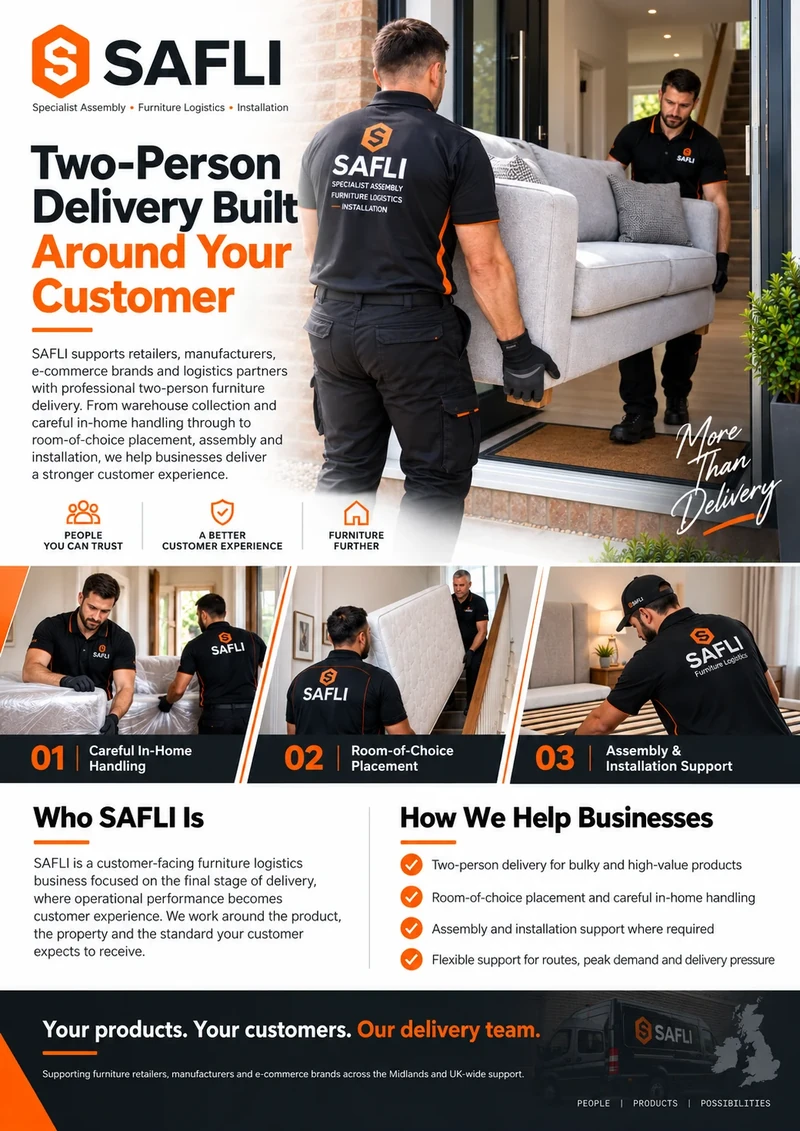
Two-person home delivery • room-of-choice placement • assembly • installation • packaging removal • failed-delivery recovery • returns • exchanges • customer collections
SAFLI can work alongside existing fleets and logistics partners or provide additional capability around a defined part of the operation.
The requirement can be structured around:
A product range • route • region • delivery programme • backlog • reverse-logistics flow
The operating requirement is agreed around the product, access, final placement, work required at the property, completion standard and evidence expected.
Where something cannot be completed as planned, the principle is equally important:
Make the exception clear, record what happened and establish what needs to happen next.
Put SAFLI against a real delivery problem
If your operation is dealing with repeat visits, failed room placements, difficult products, assembly requirements, delivery backlogs or unmanaged returns, start there.
You do not need to change the wider network.
Start with one route, one delivery day, one product range, one region or one backlog. Agree the requirement, measure the outcome and decide from there whether the service should grow.
Start small. Prove it. Build from there.
Because the doorstep was never the real destination
For furniture businesses, the final mile is ultimately judged by the customer’s experience of the finished outcome.
Customers are not comparing route plans, depot utilisation or transport systems.
They are comparing what they were promised with what actually happened in their home.
When products are large, valuable, difficult to handle or require work inside the property, the final few metres can have a disproportionate effect on the success of the order.
The strongest operators will increasingly stop asking whether the product was merely delivered.
They will ask whether the customer journey was completed.
That is where specialist furniture logistics creates value.
And that is where SAFLI fits.
Is one part of your delivery operation creating more work than it should?
Start with the route, product range, region, returns flow or service requirement creating the pressure.
SAFLI can begin with a defined trial day, delivery run or programme, agree the operating requirement and demonstrate how specialist customer-facing delivery support can work alongside your existing operation.
discuss a partnership
Continue Exploring Furniture Logistics
SAFLI shares practical insight for retailers, manufacturers and logistics teams working across furniture delivery, room-of-choice, assembly, installation and reverse logistics.
Our focus is on the operational issues that affect completion, customer experience and the wider delivery journey.
practical insight
Guidance built around real furniture-delivery challenges.
service capability
Explore how SAFLI can support your delivery operation.
Explore SAFLI Services
From two-person home delivery and room-of-choice through to assembly, installation, delivery support and reverse logistics, SAFLI provides specialist customer-facing capability that can work alongside your existing operation.
view our services
about safli
SAFLI
Specialist Assembly • Furniture Logistics • Installation
Customer-facing furniture logistics for retailers, manufacturers and e-commerce brands.